2011

Rose Power

Sunday, 4 December 2011

Shakespeare's Twitter

Someone has been regurgitating the entire works of Shakespeare, one play at a time, via Twitter.


What does this do to the works?
It certainly puts emphasis on certain words as often sentences have to be broken up to fit into the '140 character or less' format. The context is interesting, as people are most likely to read the posts amongst the other posts on their Twitter feed rather than all together.

It's amusing that the person doing this claims to be Shakespeare himself "tweeting from the grave". It leads us to imagine how great writers would cope if they were alive now; would they adapt to our fixation on social networking sites?

Saturday, 3 December 2011

Amazon vs. real bookshops

I made some images on photoshop juxtaposing images of book shelves with the obvious modern alternative; Amazon. I imagined that I could hack into Amazon.co.uk and replace the homepage with this image to remind people what they were missing.


I could add a statistic, like 'The volume of books being bought is in decline. In 2010 a total of 229.3 million books were sold in Britain, a 1.7 per cent decrease on 2009, according to research company Nielsen Bookscan.'


I tried this in the quick animation i made below. It would be great if I was a computer genius and could actually hack into the Amazon website to change the homepage! I would like to try out more animation, like making bookshelves pop up one at a time.


I'm really interested in this idea of hacking/terrorism with good and harmless intentions.

Friday, 2 December 2011

Shakespeare & Company

Me at Shakespeare & Co.

Last April I visited this famous book shop in Paris. Their eclectic scrapbook-style homepage brilliantly encapsulates their aesthetic and promotes instore events, and they use their mailing list to email information to people all over the world. But despite embracing (not fighting) the internet, it is a huge threat to them and other independent book shops.

Clip from Mourir Auprès de Toi (To Die by Your Side) by Spike Jonze 
Full version on Vimeo


This animation by Spike Jonze was made in the shop. I think it effectively uses (the internet and animation) technology to present the old fashioned world of the book shop as an exciting place.


This is useful in thinking about how I can adapt books so they translate into an online language which improves rather than destroys or cheapens literature.

Thursday, 1 December 2011

Tutorial

I talked to Jason about where my ideas are going. For my next steps I am going to summarise my research on book shops and libraries closing, and add it to my blog. I am going to compare online and analog environments, for example a real life book shop vs. Amazon, and record them photographically. I will look at the differences in experience and consider if anything is lost or gained.


I will also be looking more at the aesthetic experience of books vs. kindles and similar book 'replacements', remembering of course that books are technology themselves.

Links for investigation:

I need to do lots of thinking and mind maps.

Friday, 25 November 2011

New ideas

Today's tutorial encouraged me to focus on something that interests me. I thought literature would be a good starting point, as I love to read and technological alternatives to books seem to be everywhere.
Even when doing the reading for this project, I found it really difficult to read large amounts of text on a computer screen.Though many full books are available online, it's not the same as reading a book in real life; many people are strongly against e-reading.


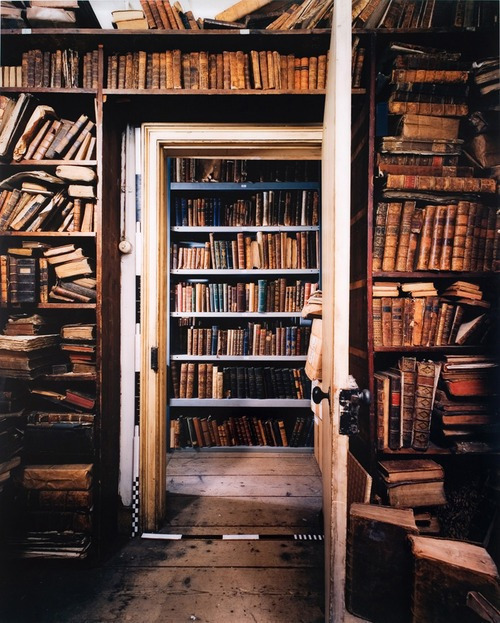
How can you have an online equivalent to this?
Via http://bookshelves.tumblr.com/
Though the internet may contain all the same information as these books (and much more) I feel that something is definitely lost. For me, having your own book that you can hold in your hands is better than looking at a bland screen of text.

Moving on

After the research part of my project proved fairly uninteresting and has not much further to go, I have decided to explore a different route.


However, the last 6 weeks have not been a waste of time:
  • I learnt about the meaning, purpose and origins of technology by reading David Nye and Giorgio Agamben and researching Aristotle.
  • I thought critically about the different platforms of social media and their powerful effects on society.
  • I considered how visual communicators using technology to their advantage as a creative practice.
  • A visit to the V&A Post-modernism show provided ideas about technology vs. real life/ real people
  • Then I delved into experiments regarding blogs as online art exhibitions (displaying my own work as an example) and comparing the types of blogs available.


I revealed that you can make almost identical websites using each blog provider and that their popularity often depends more on the followers (what kind of people they are and therefore which blog site they prefer to use*) than the blog itself.
*Though I reached some interesting conclusions about this I don't think these ideas were very exciting or original.


A previous project I was involved in, organising exhibitions in unusual places.
I explored taking artwork out of context (by posting it online) and new meaning this gave to images. I was planning to compare displays of artwork in the real world and online, for example, what would the real life equivalent of a blog look like. This does not interest me enough to continue and I would prefer to work with something more personal...

Tuesday, 8 November 2011

Reflective statement

By using blogs as the medium through which to experiment I have showed that I understood and engaged with the brief effectively. I have researched why and how people use blogs successfully to reach a wide audience, particularly illustrators using blogs as an 'online gallery' space. I have carefully considered my own voice and concerns by making the experimental blogs personal (Rose Power Illustration) but understand that the internet is vast and it would be more interesting and relevant to now expand the project outside of my own vision. I made a start on this when I chose to involve and ask the opinions of others in my first experiment.

An extract from one of my survey responses

Though I could have been more adventurous in equipping myself with new technology I consider this relevant to the section of contemporary technology I am investigating; like me, all you need to make/view blogs is a computer and the internet. This is what makes blogs so versatile, perhaps too much so. So far I have written down ideas as soon as I think of them (attempting present the messy notes in my folder more neatly on this blog). I have continuously questioned and evaluated myself (via blog posts) and this self-critical attitude came out as a strength in the peer review. I have taken a lot of notes and made diagrams but have done very little drawing, so this is something I can embrace in Coursework 2, along with making 3d models if necessary.

If given more time, I would have liked to perform more experiments, but this is what comes next. I need to look more deeply into the meaning of images being altered when they appear on blogs and how 'blogging' could translate into the real world. Ideas for physical alternatives to blogging were going to be my 3rd experiment, and this is where I will go next, but I feel this is less of an experiment and more of a development of existing research, though more research and investigation is inevitable. I am also interested in continuing to compare Tumblr and Blogspot in terms of their typical users and their different traits.

Week 6 - results of 2nd experiment


It's time to assess which blog provider I found most 'successful'; all 3 were relatively quick and easy to make, so it comes down to which one had the most followers. Blogspot gained the most followers (15) and the Tumblr had only 4. My Wordpress site had none! After making these blogs and observing their progress over a few days, I realised there needs to be more to my project than this. While it was really useful as a research exercise to make these 3 blogs, I am not yet successful enough as an illustrator (or blogger) to be able to analyse my output on a very large scale, so I'm going to adapt the next stages/direction of my project.


Some interesting findings came from this 2nd experiment though. For example, I confirmed a realisation that came up in my 1st experiment: Wordpress is nowhere near as popular as Blogspot and Tumblr appear to be! If I am to go on comparing blogs and searching for the best, this will inevitably turn into a battle between these two blogging giants!

As a fun way of making a visual summary of this experiment (and the first) I have made a flowchart which tells you which blog would suit you best, based my findings.


3 Blogs

Here are screen shots and links to each blog, as you can see I have tried to make them look as simple and as similar as possible, to emulate the 'white space' of an art gallery and so as not to distract from the images; I tried to make this less about my work and more a space where anything could be displayed.

In order of success:


Blogspot


Week 6 - Experiment 2

I created 3 illustration blogs (on Tumblr, Wordpress and Blogspot) and documented the main differences I noticed when making them. Though I consider myself technologically challenged, I actually found them all fairly easy to use.


I'll talk about Blogspot first (the one I am most familiar with). You can log in with a Google account, which is a benefit for those who use Google mail (most people I know). The screen for composing blog posts is very straight forward and there's just one for everything (text, images, video etc). You can enter your own html, but there's no need to. Anyone competent with Microsoft Word could pick this up without even trying, and it's good that you can upload more than one image at a time, though once they're uploaded they can be hard to move around.
Blogspot

adding images on Blogspot

I found Wordpress very similar to Blogspot for entering text but there were a lot more options. You can easily enter images into a text post but there is also the option to do a 'quick post' (simple text OR image, you have to choose). There is also the option to decide what 'format' your post appears in (standard, gallery status) which seem to overcomplicate things a bit but as they say on their homepage, "we have something unique" - some people might like things like this.

Wordpress


I encountered problems on Tumblr, when trying to get the posts to look consistent with the other blogs. Though it's really easy to use, you have to conform to their layout. 

I tried to post 3 images using the image post option, but Tumblr is designed to have only 1 image per post; so it put one big picture at the top with 2 small ones underneath when I wanted them all the same size. Confusing!

Instead, I tried to put the images in a text post. I used the same text for each blog to test the differences. For absolutely no reason, on Tumblr the quotation marks didn't show up in the title!? (Actually, on Wordpress the title for one of my images didnt appear at all). In an image post you can't have a title - only a caption.


Even though it was annoying that I couldnt make pictures in the same post the same size, I could easily upload them as separate posts. However, one advantage it has compared to Blogspot is that you can easily choose the order of the pictures, while on here they're really difficult to move around once uploaded.


When I tried to centre images it didn't work, I'm sure a simple bit of HTML tweaking could do this, but for someone looking for an easy blog this is frustrating.

See how the 3 blogs turned out in the next post.